Sunday, 18 November 2012

Memories of long ago.
Mothers in particular have a habit of collecting memorabillia that pertains to their children. Books, toys and other sentimental items are often stashed away for their own memories or for future passing on to their children.
My mother has been slowly dribbling items over to me when she sees me. Items such as photos, favourite toys (Didn't know you still had that Mum).
There are often times when you wish you still had childhood items just to take a jog down memory lane. Certains items can then be put in front of your own children for them to laugh at or feel sorry for you.
Todays offerings are a far cry from the toys a lot of us grew up with. Where did you shove the battery Dad?
A recent hand me down from my mother was an old Walther and Stevenson toy catalogue that she had obviously kept for over 40 years.  Walther and Stevensons were a toy shop in Sydney which closed in the early 70's. There were other 'toy shops' such as Searles, Levensons and Hobbyco which is the only survivor today.
When I searched the internet this interesting site had also recollections of Walther and Stevensons and the other shops mentioned above.
 When visiting these stores it was always to the train section first. As the years rolled by it went from the Hornby Clockwork trains to the Hornby 3 rail electric and then to Tri-ang trains which was my first electric train.
While writing this my memory goes back to a local chemist shop that for some reason had a Hornby 3 rail small layout in the shop. As it was just up the road I spent a lot of time there. Originally looking at it from the front, the chemist must of felt sorry for me and let me round the back of the layout as an operator.
I think the Hornby Dublo trains were more expensive than the equivalent Tri-ang and a kid that used to live in a big house behind ours became a best friend when I found out he had a Hornby Dublo train set.
Another school mate had a Marklin train set that were even more expensive than the Hornby Dublo. He was never as keen as I was and I had fun making reverse loops with both types of three rail set ups. I didn't at that time understand the problems that lay ahead when I tried to make a similar track configuration with two rail track that didn't work.
Way back then we still used to get junk mail delivered but the only difference with the old was that train sets figured prominately in them. This I am sure helped the hobby exist longer then. It should be interesting as we creep up to the 50th anniversary of the AMRM magazine to reflect back on how the hobby has changed in that seemingly short time frame.
I would like to share a few pages I have scanned from the catalogue so you can see what us old farts used to have. It seems so ironic that we can now whinge and scream that our models of today have a few errors or parts not modelled etc. etc.
Anyhow here they are:


alther & Stevenson were established in Hunter Street, Sydney, in 1900, making saddles and harnesses. The firm moved to 395 George Street in 1904 and remained there until they closed about 65 years later. Their usual arrangement with rural customers was by mail order and numerous requests were made for toys suitable for children's Christmas presents. This encouraged the company to open a small toy department in 1930. At this time they mainly stocked German-made toys. In 1935, a Mr A. Anderson became a director of the firm and the stock of toys increased. By the late 1930s the basement area was full of model trains, farm animals, toy soldiers and working steam engine models. After the director's son Kenneth Anderson took over the firm, the saddlery line was removed altogether and toys occupied both floors of the store. During the Second World War, when access to British and European toys was curtailed, Australian toy manufacturing flourished and many locally made items were sold in Walther & Stevenson's store including Australian-style timber farm buildings and accessories. From the 1960s versatile moulded plastics began to be used in toys instead of metal and timber. Japanese tin toys, as well as a large number of imported British and American toys forced local manufacturers out of business. Walther & Stevenson failed to move quickly enough with the times and had to close in about 1970.

Read more: http://www.powerhousemuseum.com/collection/database/?irn=379852#ixzz2CY0GXMhS
Under Creative Commons License: Attribution Non-Commercial
Walther & Stevenson were established in Hunter Street, Sydney, in 1900, making saddles and harnesses. The firm moved to 395 George Street in 1904 and remained there until they closed about 65 years later. Their usual arrangement with rural customers was by mail order and numerous requests were made for toys suitable for children's Christmas presents. This encouraged the company to open a small toy department in 1930. At this time they mainly stocked German-made toys. In 1935, a Mr A. Anderson became a director of the firm and the stock of toys increased. By the late 1930s the basement area was full of model trains, farm animals, toy soldiers and working steam engine models. After the director's son Kenneth Anderson took over the firm, the saddlery line was removed altogether and toys occupied both floors of the store. During the Second World War, when access to British and European toys was curtailed, Australian toy manufacturing flourished and many locally made items were sold in Walther & Stevenson's store including Australian-style timber farm buildings and accessories. From the 1960s versatile moulded plastics began to be used in toys instead of metal and timber. Japanese tin toys, as well as a large number of imported British and American toys forced local manufacturers out of business. Walther & Stevenson failed to move quickly enough with the times and had to close in about 1970.

Read more: http://www.powerhousemuseum.com/collection/database/?irn=379852#ixzz2CXzdHEYO
Under Creative Commons License: Attribution Non-Commercial

Any one having a memory lane trip??
Walther & Stevenson were established in Hunter Street, Sydney, in 1900, making saddles and harnesses. The firm moved to 395 George Street in 1904 and remained there until they closed about 65 years later. Their usual arrangement with rural customers was by mail order and numerous requests were made for toys suitable for children's Christmas presents. This encouraged the company to open a small toy department in 1930. At this time they mainly stocked German-made toys. In 1935, a Mr A. Anderson became a director of the firm and the stock of toys increased. By the late 1930s the basement area was full of model trains, farm animals, toy soldiers and working steam engine models. After the director's son Kenneth Anderson took over the firm, the saddlery line was removed altogether and toys occupied both floors of the store. During the Second World War, when access to British and European toys was curtailed, Australian toy manufacturing flourished and many locally made items were sold in Walther & Stevenson's store including Australian-style timber farm buildings and accessories. From the 1960s versatile moulded plastics began to be used in toys instead of metal and timber. Japanese tin toys, as well as a large number of imported British and American toys forced local manufacturers out of business. Walther & Stevenson failed to move quickly enough with the times and had to close in about 1970.

Read more: http://www.powerhousemuseum.com/collection/database/?irn=379852#ixzz2CY0GXMhS
Under Creative Commons License: Attribution Non-Commercial
Walther & Stevenson were established in Hunter Street, Sydney, in 1900, making saddles and harnesses. The firm moved to 395 George Street in 1904 and remained there until they closed about 65 years later. Their usual arrangement with rural customers was by mail order and numerous requests were made for toys suitable for children's Christmas presents. This encouraged the company to open a small toy department in 1930. At this time they mainly stocked German-made toys. In 1935, a Mr A. Anderson became a director of the firm and the stock of toys increased. By the late 1930s the basement area was full of model trains, farm animals, toy soldiers and working steam engine models. After the director's son Kenneth Anderson took over the firm, the saddlery line was removed altogether and toys occupied both floors of the store. During the Second World War, when access to British and European toys was curtailed, Australian toy manufacturing flourished and many locally made items were sold in Walther & Stevenson's store including Australian-style timber farm buildings and accessories. From the 1960s versatile moulded plastics began to be used in toys instead of metal and timber. Japanese tin toys, as well as a large number of imported British and American toys forced local manufacturers out of business. Walther & Stevenson failed to move quickly enough with the times and had to close in about 1970.

Read more: http://www.powerhousemuseum.com/collection/database/?irn=379852#ixzz2CXzdHEYO
Under Creative Commons License: Attribution Non-Commercial


Saturday, 3 November 2012

The Main North
Last night after much choosing of dates our group was lucky enough to be able to make a visit to Marcus Ammanns' layout. Unfortunately some of the group couldn't make it which indirectly lead to more cake and more room there for the three of us.
For those who don't know Marcus he is regarded as the DCC guru. Having a background in electronics certainly helps the situation. Some improvements in DCC technology have been improved due to his direct inputs. All good news for the hobby.
His layout the Main North is based on selected stations and scenes from Sydney to way up near Gunnedah.  Checking out the link for his web page also reveals a track plan which although three years old looks close to what we saw on the night. One slight change to the plan though. Although the plan shows the location of his wifes car in the garage, a recent update with a newer car has resulted in the car being now too high to fit under the non moveable part of the layout. Its what I call a win win for both parties.

The first photo shows the scene on entry to the room. A lift up flap gets you into the room. On this portion of the layout Werris Creek is on the top level and Broadmeadow on the lower level. You will notice a variety of chairs ranging from the first class chair (with arms), two second class seats (No arms) down to the hard third class milk crate which was put into use on the night, the host generously volunteering to utilise it. The workbench can be seen on the right hand side.

The layout resides in a double garage although this is hard to realise when you first step into the room. The 'S' shape aisleway works it way through the garage and on either side is generally double decked layout. The layout is well lit with lighting behind recently painted valances which look very smart painted in black. Location signs nicely produced in the NSW bar with circle style were ready to be placed into position.

In the above photo Sulphide Junction is on the bottom deck on the right hand side. Now having come down a step in the centre of the photo this now puts the station above Sulphide at about my forehead level. The plan of the layout showed a step that was once? provided for operators shunting on the top deck. You would get no complaints from Ray Pilgrim or Ian and Andrew from Bowen Creek but for the rest of us the only way to view it would be to do a Watusi/Zulu dance which would be rather tiring if you were given the pickup to shunt. Maybe Marcus has something in mind for the future.
The layout is laid with code 100 points and track and according to the layout plan runs for around 70 metres. At the moment no ballast has been laid. Marcus has put a lot of thought into the layout design and with a combination of selective compression and imagination it all works.

As can be seen from the photos scenery at this point in time is not very widespread. As they say Rome wasn't built in a day. It all takes time. Throughout the layout there are many buildings positioned already waiting for the grass to grow around them.
The above coal stage was a win off Ebay and sits in position awaiting connection to the layout.
The above relief building represents Cardiff workshops with Tickhole tunnel in the background heading off towards the next station through the backscene.
At the opposite end of the previous photo is the representation of the Sulphide Junction works, the ultimate destination of the W44 ex Broken Hill concentrate train. This train was run on the night with a double header consisting of a 35 and 60 class locos.
As stated at the beginning the layout is run on DCC. My current layout is DC, a spaghetti junction control panel and wired controllers. This I must admit was my first hands on trying out the DCC system. I can see why it is the ideal system and for various reasons such as cost, how do I get the flipping top of some of the locos??, what wire goes where? and what do I do when I can't find the short or the whole system just shuts down I will stay with my current setup for the time being.

NEWSTAN MINE
On the night I was given a double headed coal train from Newstan Colliery and had to take it up to Port Waratah. Marcus has made job cards which are about credit card size that fit onto the top of the hand controller. They give all the clear instructions needed to run your train. First off I had to get a single Garratt from a road in Broadmeadow and take it around to Fassifern then into the colliery branch. There was already another garratt waiting and the task was to put together two rakes of eleven hoppers, grab a brake van from a siding then with the double header reverse the consist out onto the main then set forward up "Fassifern Bank" With an actual grade on the layout as I headed up the grade Marcus said hit the F9 button which increased the tone to represent the loco working harder but not faster. I was suitably impressed.
As the train approached Sulphide Junction I was advised although the train was on the down track it started heading into the up refuge. This was mainly due to a human log jam in the aisle and I was tagging along with the train 22 wagons back near the brakevan. No problems though as the track was close in design to the prototype we switched back to the Down Main and off to Broadmeadow. There after a bit more shunting the train headed around to Port Waratah. Time then for another coffee break.
Just outside of Muswellbrook Marcus has scratch built this great compressed model of the Oak Milk factory which really captures the feel of the real building. Wouldn't it be great if Auscision chose this as the next building after the silos???. You can see the new SDS Oak milk wagons are ready for filling. No doubt these will be added to a job card for pickup to Hexham.


Another view of the layout showing the two levels with the Newstan colliery on the lower right and the Oak factory at Muswellbrook on the left hand side. The coal train I ran awaits the arrival of the light engine from Broadmeadow.
Well after a few hours of chewing the fat, running trains eating and drinking and good company we departed. I'd like to thank Kevin Waid for the photos above. It was a great night, thanks again Marcus.


Wednesday, 10 October 2012

SRC for SCR

Well the Liverpool exhibition is over again for another year. I must give congratulations to the team that put it all together. Well done for the fiftieth. I must admit I probably missed the first couple but have been a regular since the Lower Town Hall days and don't think I have missed any up to now.
The extra tent filled with layouts was welcomed. The only comment regarding the layouts for me was there were very few layouts I hadn't seen before, and this certainly doesn't detract from seeing them again.
It is a costly exercise to build an exhibition layout, transport it and show it off and then after three exhausting days pull it all down and return home. The fabulous Coffs Harbour layout must fit this category. With closing at 5.0pm on the Monday they would have been there long after tea time before heading home up the Pacific Highway, thats if they made the trip that night.
My choice of visiting day was on the Monday. Through forums and other discussions I heard people were queuing up for an hour or so just to get in the door, and when the tribe got in there you couldn't get close enough to a layout to see it for all the people. Was this all supposed to be for the "so called bargains?". Having arrived on the Monday right on 9.0am I strolled straight into the main hall with hardly any one there. By midday there were a lot more lookers.
My only rolling stock purchase for the day was a pack of SRC refrigerator wagons and very nicely done Mr Easy. I got some scenic material from the Orient Models stand as well. 
Well I got the three 'virgin' white SRC's out of the packet and weathered them up a bit. They certainly look different now than from the box. Its hard to get good reference photos in colour for weathering purposes, so anything goes. I was lucky to catch them on a garratt led train just leaving Bega and managed a few shots.


Derelict 42213 at rear of Bega loco


Now the next shot with the two 44's is probably a failed attempt at an atmospheric scene supposed to be on a foggy morning. I'll say maybe 5 out of ten at a pinch.
How else do you create fog? With a fog machine of course. About two years ago Aldi had a fog machine co-inciding with Halloween - Trick or Treat time. It was around $50 and I could not justify that much for a photo or two. Last year they had the same machine down to around $30 so I thought why not. So I had this machine sitting under the layout for nearly a year and decided I had better try it out.
After unpacking, setting it up and filling up with the liquid after eight minutes of warming I pressed the remote button and out pumped some fog. A few dense clouds hung around and needed hand stirring to get the thinner effect I wanted. The fog also seemed to effect the colouring in the photo. The fumes were certainly not flavoured nicely but I hoped they weren't toxic. The tank ran out of juice before I could take more shots. 
I suppose I would have to call it a failure and not the end result I hoped for.
I may have another go another day but its next use which will be coming up soon will be to put it behind the screen door and when the little blighters knock on the door and call out 'Trick or treat' I can call out "Neither, get this lot of fog into ya". It will be along the lines of the fog machines they are installing in banks now. Mum will be at the front gate yelling "Johnny are you in there somewhere?" Hopefully Mum will put an 'X' on the front gate meaning don't go there next year.
 
 So after the fog had cleared I was able to get a clearer shot of the 44's on the bridge near the gully working a coal train.
 The next shot shows the Candelo coal mine in the background. This is where the train had originated from some time ago.
So far it has been a very quite year for SCR and there will be a few interesting months ahead to see how we progress. Watch this blog.
I'm also glad to that Blair 'North of Narrabri' is alive and kicking after a long abscence from his blog even if his posting has a plane on it. Come to think of it his mate Lance has been quite as well. Hope he is pounding away on his new layout.
It seems sometimes if you haven't posted after a few weeks they send the undertakers around to see if you are still alive and kicking.

Sunday, 9 September 2012

Whether to weather
Following on from the last posting the BSV's have done a couple of laps around the layout and now is the time for a weathering.
For a few reasons I haven't been down the shed as much as I would have liked recently. With the cold weather and another project which is coming to a close more time can now be spent on the layout.
I decided to weather a BSV with the tried and trusted isopryl alcohol used as a thinner for the Tamiya paint. The first I heard of using the alcohol was through the AMRM and the excellent article by James McInerny on weathering. It works very well and dries quickly. (I am still waiting for James to do an article in AMRM on how he takes his brilliant photos in the magazine, or maybe its a trade secret?)
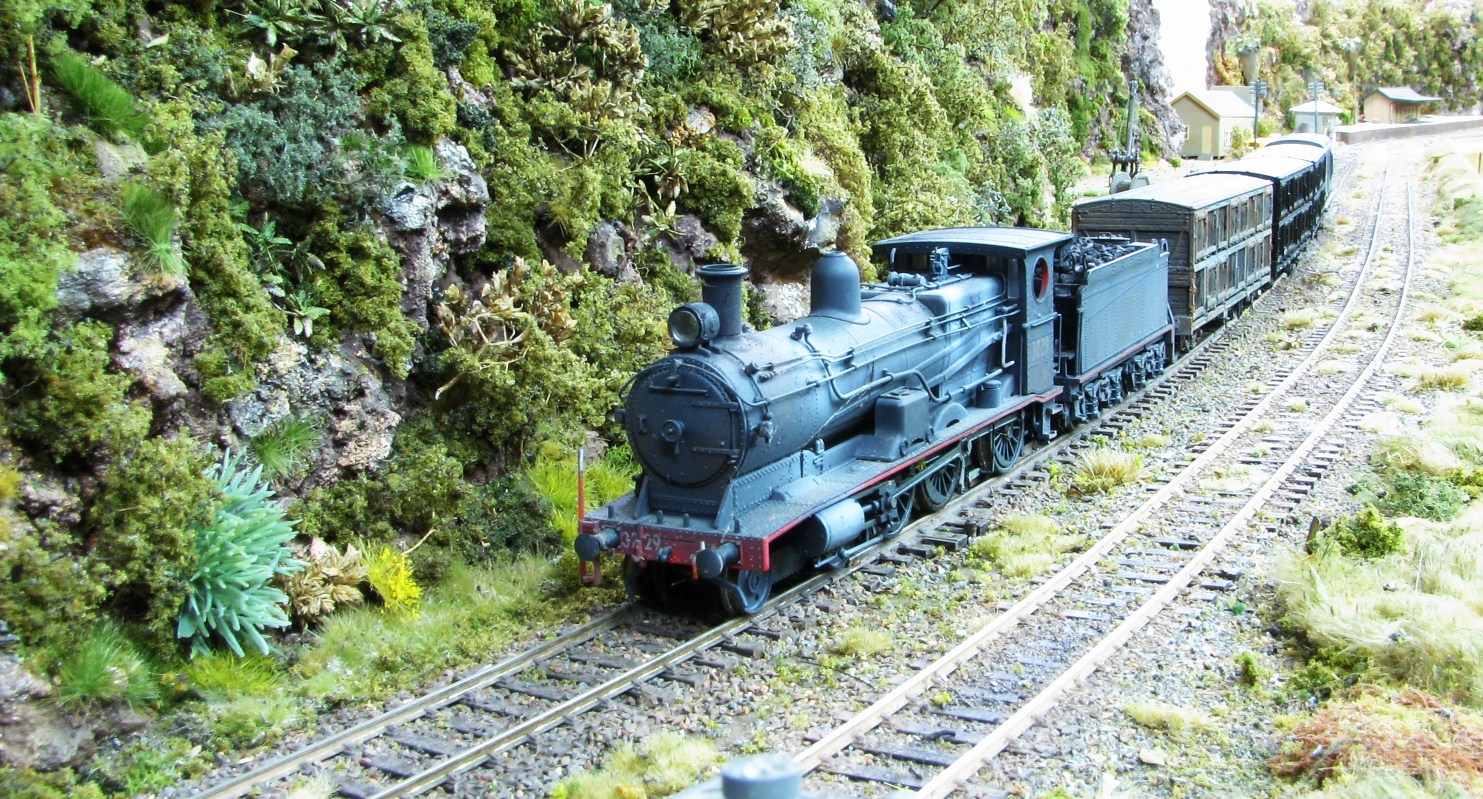
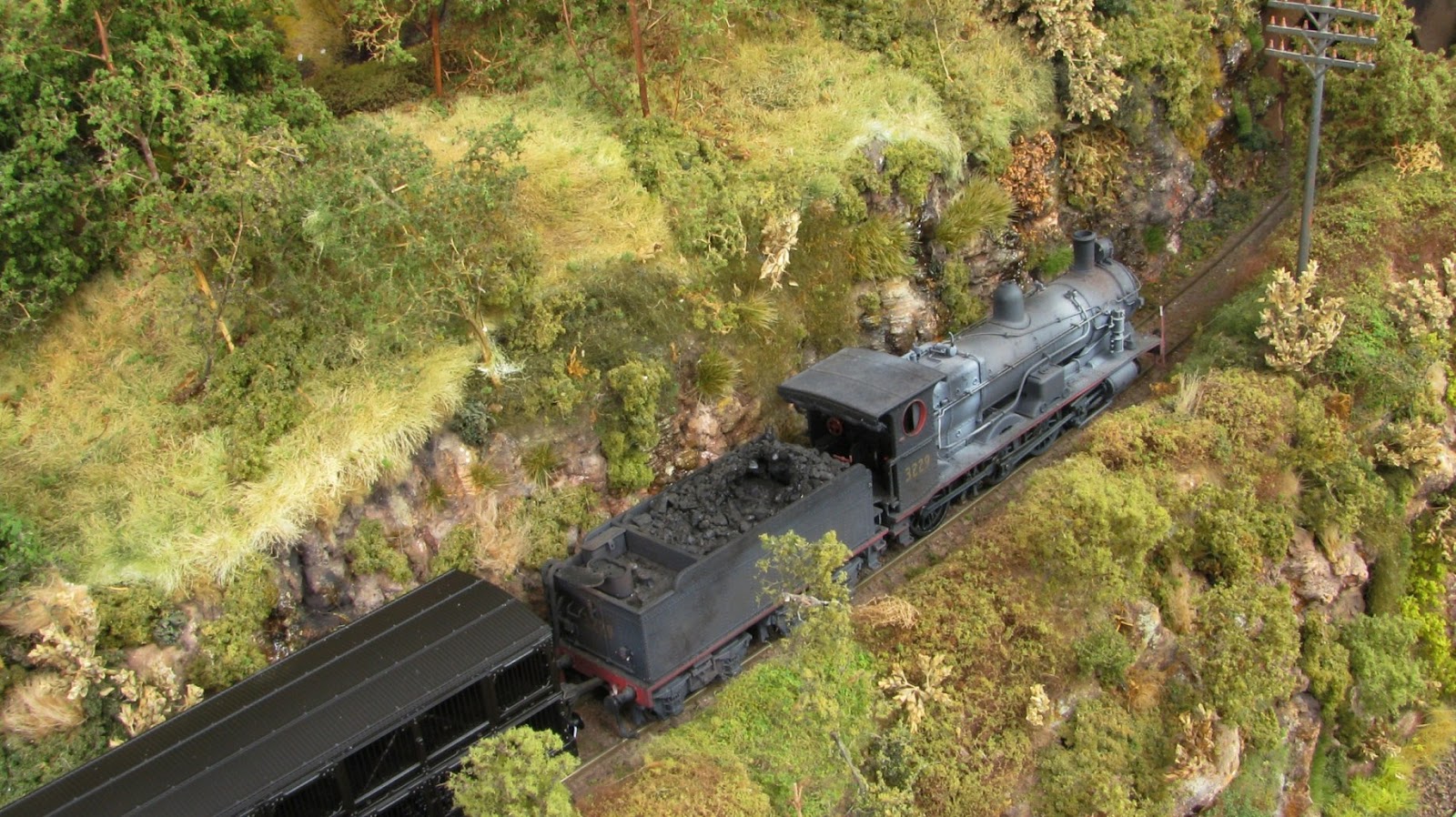
The photo above shows 3229 out on a run down at Bodalla with the weathered BSV up front. I think the rust is a bit overdone as I couldn't find the smaller brush. Even allowing for the rough job I have done it is an improvement over the out of the box models. If I have only one critisism of the models it would be the over accentuated wood grain on the ends of the cars. I might have a go at smoothing it off on the next weathering job. Although I have read how to dismantle the cars to get to the inside at this stage it is not that noticeable that the inside is still black. Will be interesting as to how modellers model sheep inside.
This is a closer shot showing the differences between the weathered and virgin out of the box model. The bow on the solebar on the right hand model is explained by having the halogen lights too close and on for too long. Will need to put the light back on and have an unbending moment.
With the batteries fully charged I took the opportunity to snap of a few more shots around the layout with the 32 and the BSV's.
One thing I get caught with every time when taking photos is I forget to go around the models with a brush to get off all debris and spider webs which my shed is a home for. I'm sure they get together outside and reccomend my shed as a good place to live. So forgive me with some of the shots that have webs on the loco. I'll make sure it doesn't happen next time.

The 32 class was waiting at Bodalla for a 44 class hauled freight to come by. The BSV was shunted off into the siding.
32 and BSV in the goods siding at Bodalla.
4429 arrives at Bodalla with yet another similar train to what the 32 class was hauling.
In a few more weeks the Liverpool exhibition will be in full swing and I am looking forward to getting some more models.


Sunday, 12 August 2012


.


First off, all's OK. It seems like its a long time between blog these days. I have had a few other projects on and the cold weather on at the moment isn't helping. 
Its been a while since I have been down the shed.(Its hard to walk around the layout with a blanket wrapped around you). Ever try operating your throttle with ski gloves on? So progress is slower during the colder months.
But I had reason to go down there today when a package arrived in the mail this week. I was a bit concerned had the postman been watching the Olympics and tried discus throwing my package from Uncle Ron up the driveway. 
I knew the BSV's were due but have now resolved as with many other models not to worry about when they will arrive. Its become a dying hobby in more ways than one. That Bee Gee's song "Staying Alive" becomes more relevant as each day rolls by.
Friday was spent drooling over the BSV's and Saturday wiping it off. I was always reluctant to buy the Bergs bogie sheep vans as they were not a well done model.
As I model the 50 to early 70's era (allowing for the 422 class when ever it gets here) I haven't been interested in many of the recent releases. The Austrains 4 wheelers will fit the bill and I hope in future JE will release these a single wagons for purchase.
So to celebrate the BSV's arrival I managed to get the 32 class to take the new wagons on a trip around the layout. The following shots were captured at the usual gunzel spots, so I hope you enjoy.
Hopefully they will get a good dose of weathering and allow them to blend in with the rest of the stock.

Sunday, 1 July 2012


 "WARNING" Read this before operating your layout.
Well from today Sunday 1st of July 2012 will be the day railway modellers will well remember.
Yes welcome to ‘Carbon Tax day’. This is a sad day we were promised we would never have.
It has been made sad because from now on electricity along with a host of other things are going to be dearer.
Now this can have a very detrimental effect on the model railway hobby and I will try and explain why with a few dot points:
  •  Most layouts are lit by electricity. Now to save costs bulb wattages may be reduced. I take a dim view of this.
  • Candles might be brought in to replace electric lighting creating a fire risk where you may end up burning the layout down.
  • When you say to your wife/partner “I think I will go down the shed for a few hours and run some trains.” Now you won’t be able to afford the electricity and surprise her by returning early.
  • There will be no more double headers run on the layout. All trains will now consist of single engine loads.
  • To overcome the above dot point, locomotive manufacturers are going to be hounded to supply dummy units to be able to replicate double headed consists at minimum cost.
  • E bay is going to be flooded with model railway equipment as operators can’t afford the electricity for the hobby any longer.
  • A new found interest will be had for clockwork trains as they make a resurgence. The old trains will be found but not the key to wind them up.
  • Sales of solar panels to power layouts will go up. Running days will in the future be held during the daylight hours. The number of locos brought along to these days will be dependent upon checking the weather before departing home. A bright sunny day will allow at least three locos to be brought along. Rainy day just bring along the cakes and beer.
  • Exercise bikes will be rigged up to generators. Each operator must do the equivalent of half an hour on the bike before being allowed to even consider driving a train. If your friends layout is generator driven and your not getting many invites to running days, it could be because you are getting too old and can’t output your half hour as you could when younger.
  • For the above dot point there is the ACCC solution. Now those initials don’t stand for what you think but “ A Carbon Cake Credit” Call it a bribe if you like but if you bring a cake along then this allows you to bypass the bike/generator ride. This slightly resembles how the real carbon fiasco will work. (But not with cakes)
  • You start playing with your son’s Thomas the Tank engine trains as you realise it costs nothing to play with. You still find it hard to accept the smiling face at the front of all locos having been accustomed to the fine detailed models coming out of China. (None with smiley faces on them)
  • In the future replacement ‘carbon brushes’ for the motors will become an under the counter product. They will go under the code name ‘motor brushes’. An email is soon to be sent to all hobby shops in Australia advising them of this name change.
  • A shortage of point throw levers will happen when owners convert back from electric powered points to hand thrown.
  • All headlight and marker lights on locomotives will be disconnected and as for the new craze of lighting your passenger carriages – forget it. Let them travel in the dark. Why bother anyway, most of the carriages run empty.
  • Electric colour light signals will be backdated and replaced with semaphore signals. How you refill the kerosene lamps is your problem.
  • You run a train up the branch but decide to terminate at the previous crossing loop. The loco runs around and heads back to town. Passengers are left to walk in to the terminus.
Well I'm sure you will be able to add to the list above, and I hope this tax doesn't have too much impact on the hobby. Enjoy.

Sunday, 17 June 2012

Yet More Scenery Work
Its one of things you have to keep at to make some progress. Saturday night saw a few hours 'attacking' the hill that was in last weeks blog.
This involves planting greenery to get rid of that solid wall of plaster. I am happy with the progress and a few more weeks and I'll move onto somewhere else.
I used some gloss spray onto the rocks to represent wet rocks something that generally happens around tunnel mouths and rockwalls. The spray didn't seem to stay glossy on the rocks but during the week I purchased some acrylic gloss medium and painted it onto the rocks. The results can be seen in the photos.
You can spend too many hours on scenery making fine detail that is only obvious on close inspection, and the beauty of us getting older is that our eyesight is not up to seeing fine detail anyway. As long as you are happy with your results that all that matters.
The scenery this weekend was above the tunnel mouth and just to the right of the tunnel. Being at the base of the cliff a more lush growth was taking advantage of plenty of moisture.


Here are a few shots as I just happened to be near the tunnel with a camera when two freights, one hauled by a 44 class and the other a 421 class went by.

Sunday, 10 June 2012

Say Cheese.....
Mention the far South Coast of New South Wales and probably 13 out of 100 people will nominate 'cheese' as a product of the region. You would probably have gotten 82 out of 100 to mention the dairy industry.
But how many towns down that way are named after cows? There is no town called Hereford or Fresian. (although it does get quite nippy). Right so how many towns are named after 'cheeses' At least three I can think of. There is the big one and still going strong 'Bega', the lesser known 'Bodalla' and there is 'Kameruka'. And not by accident these three towns are modelled on South Coast Rail.
Nearly everyone knows the Bega brand and it being the most well known brand happens to be the largest town on the layout.
The above photo of the dairy siding is situated right behind the platform at Kameruka. You would have to be pretty dumb not to realise that the building was not a Kameruka icon. Now to reinforce the point. I recently had given to me a wrapper from a slice of Kameruka cheese. Although the slice of cheese was long gone it was the label that had me interested. I thought if I could scan the label then this would make an authentic sign that could be stuck onto the building. And what would be the greatest accolade would be if a real Kamerukan person was to see and recognise the label on the building.
The donor of the label Wayne was also modelling the same area as me so we had a common interest. He was going to include Eden as one of his stations. I suggested he should have a 'garden' as the main feature as I don't think anyone make HO scale whales at this stage (Go Google if you don't understand the link).
I guess this is the beauty of modelling a ficticous region. This area is so close to the Victorian border and with all the Vic models now flooding the market this is a great reason to justify modelling two systems.
This Monday I will wander down to the Epping Model exhibition and hopefully pick up my cheque from the second hand stall. I had a clean out of some models to raise coinage for recycling into new models. I resisted the temptation to visit the second hand stall cattle crush/stampede on the Saturday morning and will enjoy the more relaxed time on the last day.
Some time ago I had an ex work collegue bring over his sound Eureka 38 class. I then thought I wonder if the two sound locos would work OK together and what would it sound like. So we coupled them up and run them up from Bodalla over to Bega on a short freight. I did a quick video and put the result here. Not a great video but a record in time.